Project Description
This project is a fully functional end-to-end large language model (LLM) translation application designed to demonstrate how modern AI-powered systems can be built, structured, and deployed using LangChain Expression Language (LCEL). The primary goal of the application is to translate text from English into a user-defined target language, while showcasing best practices for composing and serving LLM pipelines in a clean, maintainable, and extensible way.
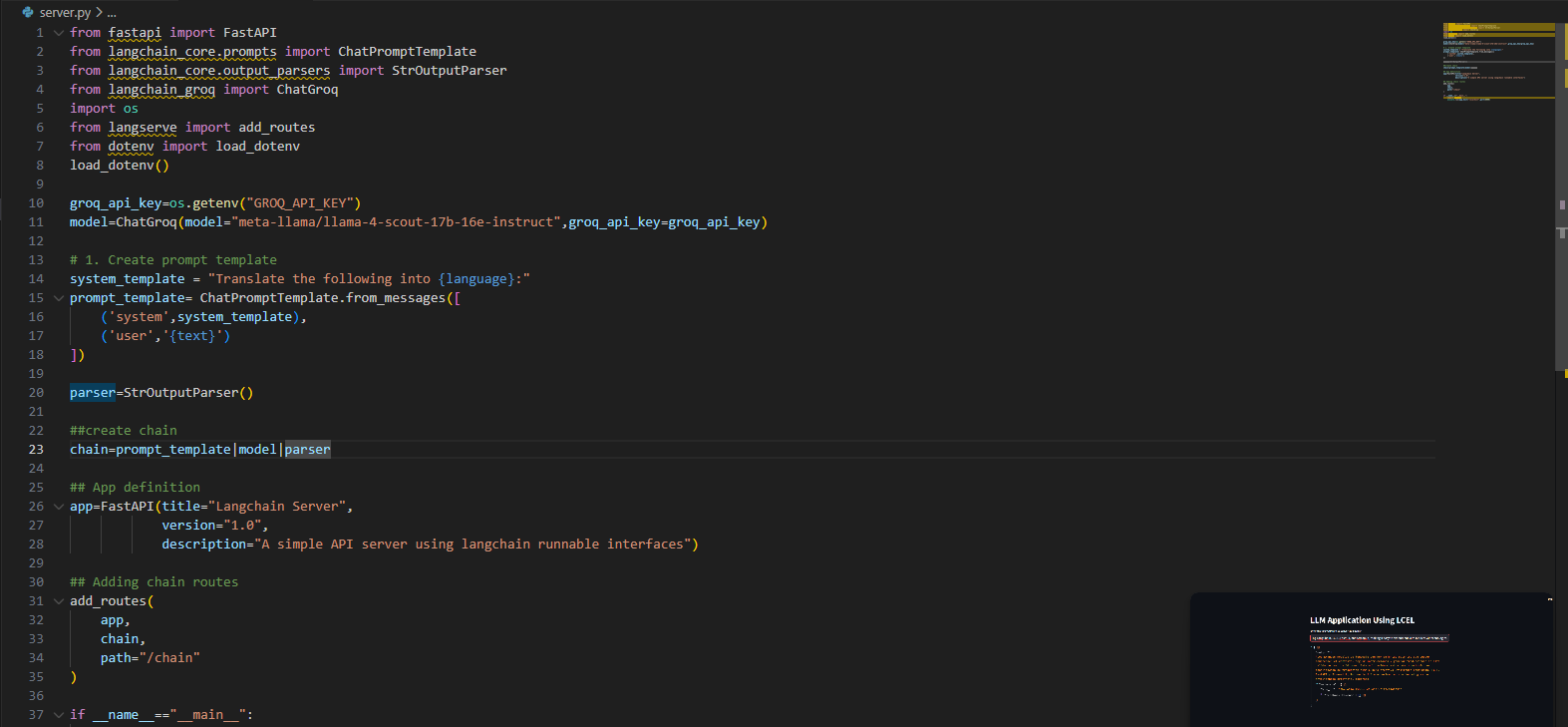
At the core of the system is a Groq-hosted LLaMA model, which provides fast and high-quality natural language generation. Rather than interacting with the model through ad-hoc prompts or one-off scripts, this project emphasizes the importance of building a well-defined pipeline. Using LCEL, the translation workflow is expressed as a clear chain of components, including input handling, prompt templating, model invocation, and output parsing. This approach makes the logic behind the translation process explicit, reusable, and easy to reason about.
The backend of the application is implemented using FastAPI and exposed via LangServe, which allows the LCEL chain to be served as a production-ready HTTP endpoint. This backend layer acts as the orchestration engine of the system, receiving structured input payloads, passing them through the LCEL pipeline, and returning clean, predictable outputs. By exposing the chain through a REST interface, the project demonstrates how LLM-powered functionality can be integrated into larger systems or consumed by multiple clients.
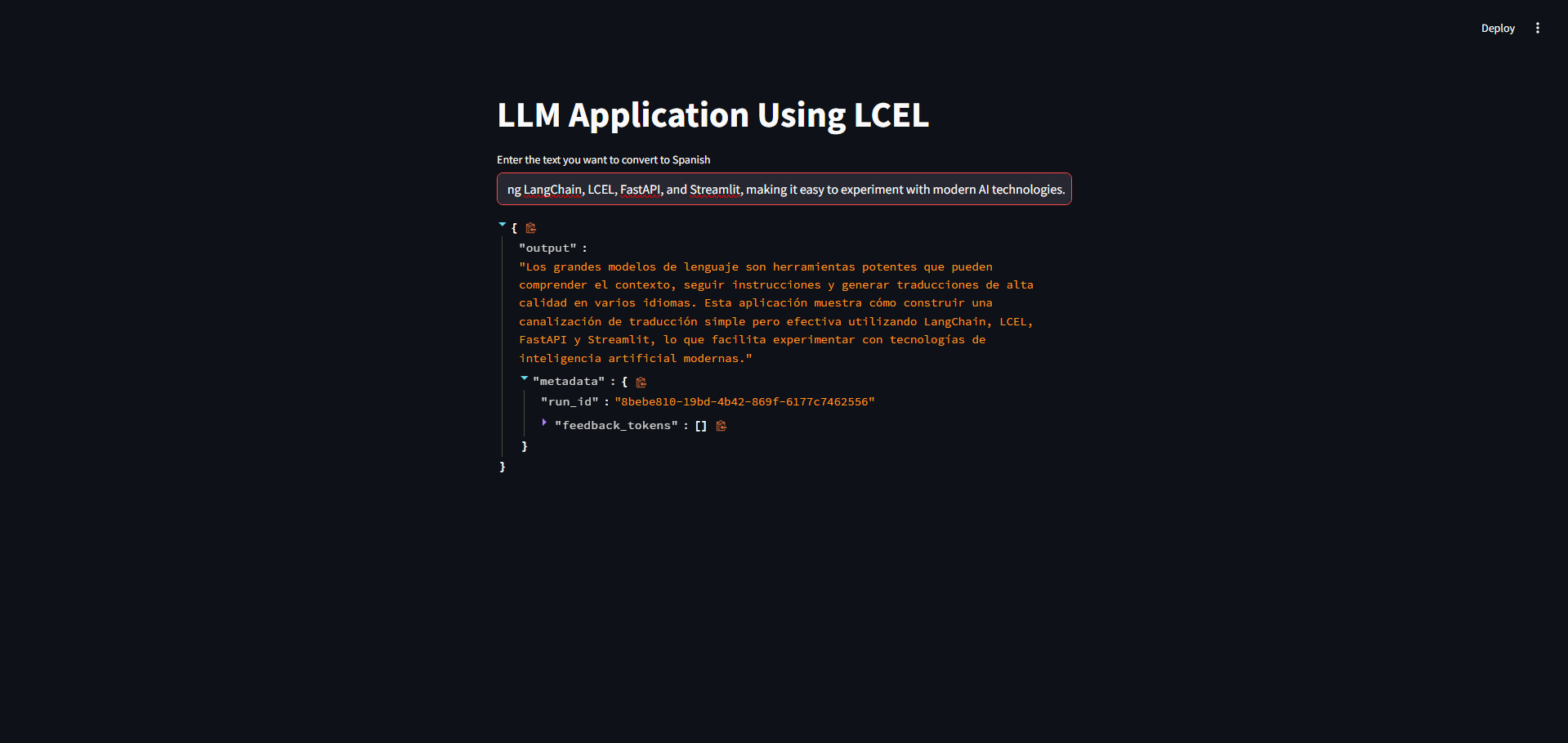
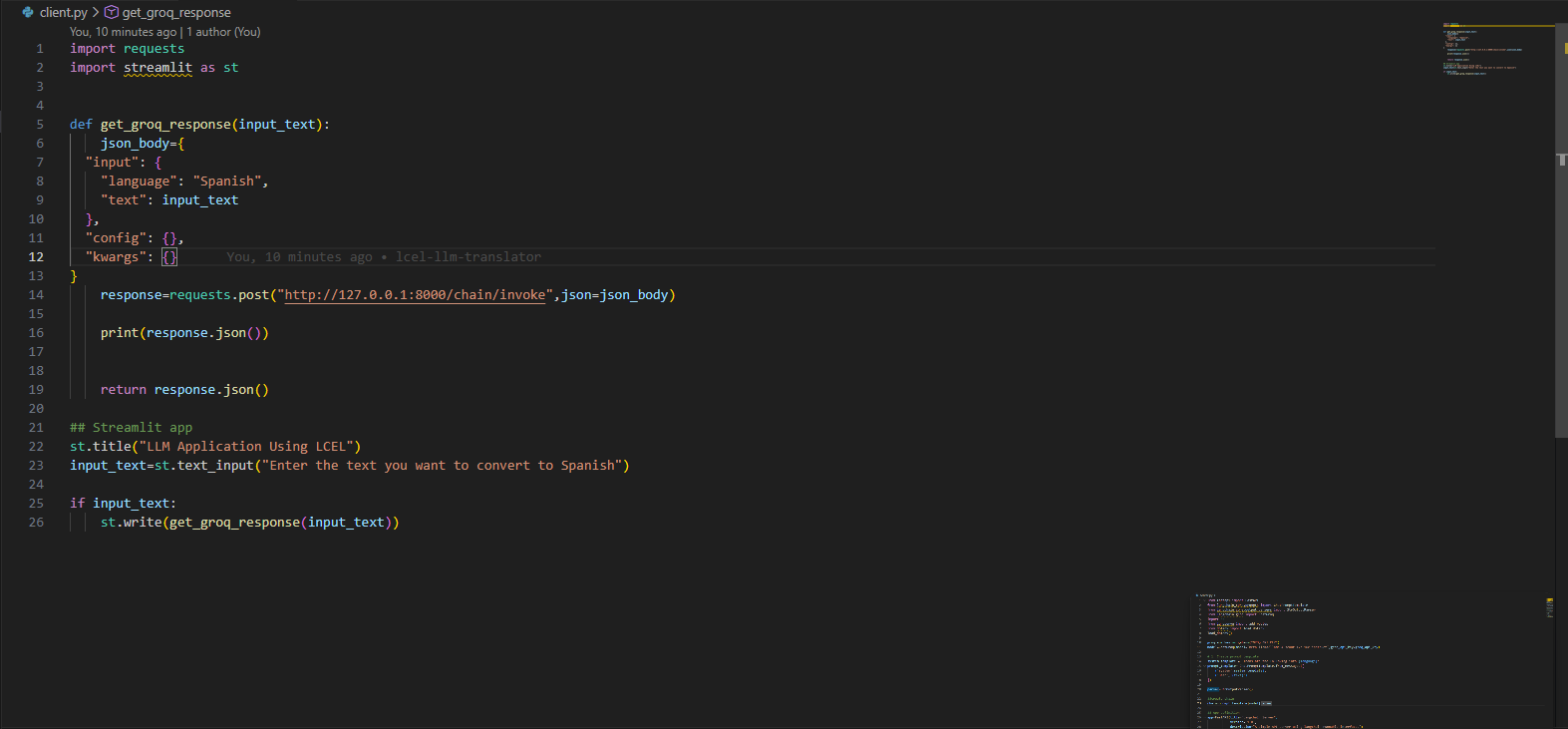
On the frontend side, the project includes a lightweight Streamlit application that serves as an interactive client. This interface allows users to select a target language, enter arbitrary text, and instantly view the translated output. The Streamlit client communicates directly with the FastAPI backend, providing a clear separation between presentation and inference logic. This separation mirrors real-world application architectures, where LLM services are often consumed by web, mobile, or desktop clients.
Configuration and security are handled through environment variables loaded from a .env file.
In addition to the runnable application, the repository includes an educational Jupyter notebook that breaks down the system step by step. The notebook starts with simple, direct calls to the LLM, then introduces prompt templates, output parsers, and finally demonstrates how these components are composed using LCEL. This progressive approach makes the project especially useful as a learning resource for developers who are new to LangChain or to large language model workflows in general.
From a technical learning perspective, this project demonstrates several key concepts: how to structure prompts for reliable translation, how to enforce consistent output formats, how to expose LLM logic as a service, and how to connect that service to a frontend client. While the current implementation focuses specifically on translation, the same architectural patterns can be easily extended to other use cases such as summarization, content generation, question answering, or multi-step reasoning pipelines.
Overall, this project is intentionally designed to strike a balance between simplicity and realism. It is small enough to be understood end to end, yet complete enough to reflect how LLM-powered applications are built in production environments. As such, it serves both as a practical demo and as a foundation for more advanced AI systems built on top of LangChain and LCEL.