Digital developer resource
Web Application Security Checklist
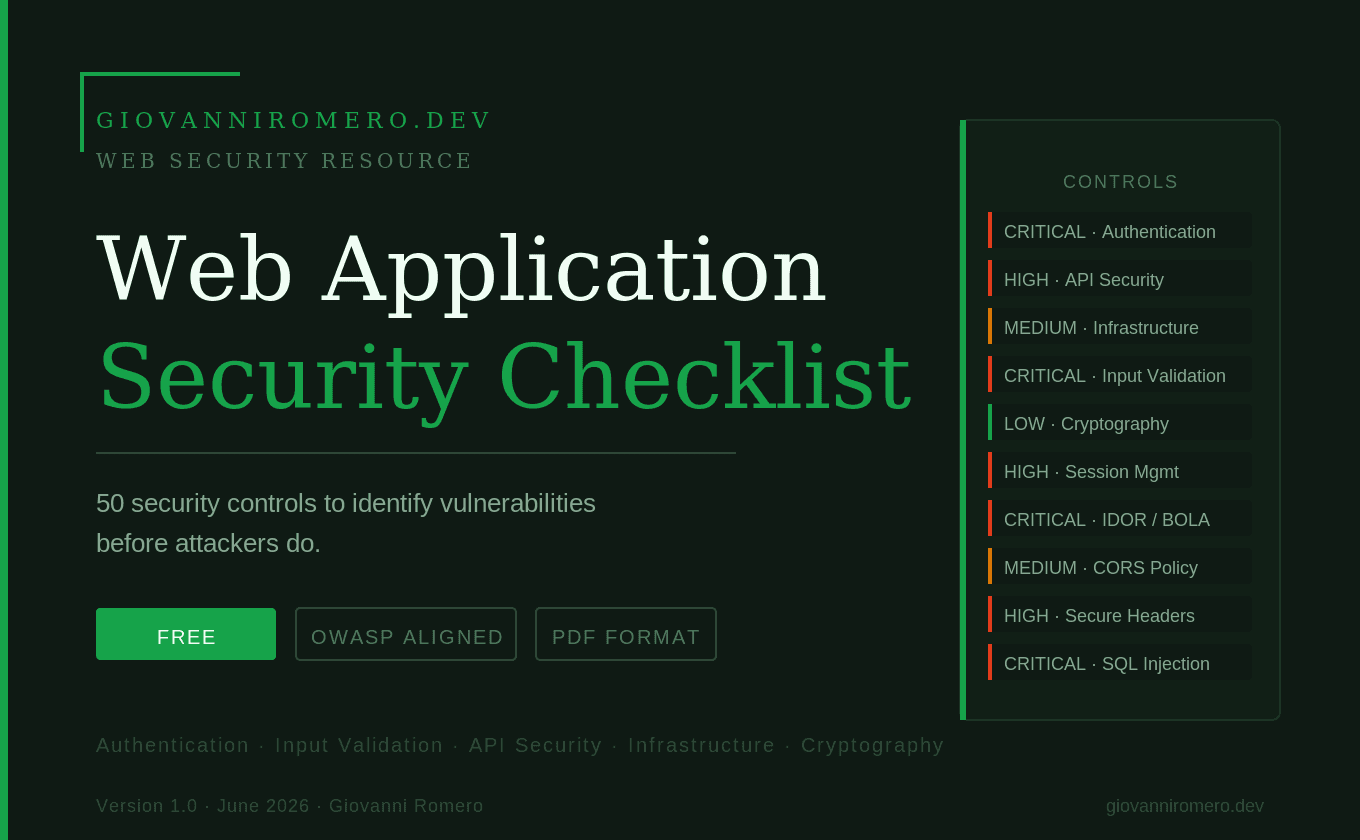
50 security controls to identify vulnerabilities before attackers do. Covers authentication, input validation, API security, session management, infrastructure hardening, and cryptography.
Features
- 50 security controls for web application reviews
- Covers authentication, authorization, sessions, and input validation
- Includes API, infrastructure, logging, and cryptography checks
- Useful before releases, audits, and remediation planning
Resource Details
What's inside
A practical, OWASP Top 10 aligned checklist covering 50 security controls across 6 critical areas:
- Authentication & Access Control — MFA, session tokens, RBAC, IDOR prevention
- Input Validation & Injection — SQL injection, XSS, XXE, SSTI, command injection
- API Security — Rate limiting, CORS, JWT validation, BOLA/IDOR
- Session & State Management — CSRF, session fixation, timeout policies
- Infrastructure & Configuration — Default credentials, HSTS, security headers, WAF
- Sensitive Data & Cryptography — Password hashing, encryption at rest, TLS
Each control is tagged with severity: Critical, High, Medium, or Low.
Who is this for
Developers who want to audit their own application before shipping, CTOs reviewing their security posture, and teams preparing for a professional pentest.
How to use it
Work through each section before launching a new feature, after a major refactor, or as part of your regular security review cycle.
Practical Use
This resource is designed as a production-oriented starting point rather than a generic download. Use it to speed up implementation, improve review quality, and document decisions clearly. Adapt the details to your own stack, validate assumptions in your environment, and pair the resource with manual review when the workflow affects security-sensitive behavior.
Review Guidance
The checklist works best when each control is tied to evidence: configuration screenshots, code references, request and response examples, or test notes. That makes the output useful for both engineering teams and security reviewers, and it helps track remediation across releases.
Documentation
Use the checklist during implementation, pre-release reviews, or remediation work. Treat each item as a control to validate with evidence, not only as a yes/no question. For higher-risk applications, pair the checklist with manual testing and code review.
FAQ
Who should use this checklist?
Developers, founders, and security reviewers who need a practical baseline before shipping or reviewing a web application.
Does this replace a penetration test?
No. It helps reduce common issues before testing, but it does not replace manual security assessment or threat-specific review.