 giovanniromero.dev
Understanding Manhattan Distance: A Comprehensive Guide
Understanding Manhattan Distance Manhattan distance is a crucial concept in various fields, including mathematics, computer science, and data analysis. This metric measures the distance between two points in a...
Understanding Manhattan Distance
Manhattan distance is a crucial concept in various fields, including mathematics, computer science, and data analysis. This metric measures the distance between two points in a grid-based system, and it plays a significant role in algorithms, machine learning, and spatial analytics. In this article, we will explore the theory behind Manhattan distance, its applications, and how to calculate it effectively.
What is Manhattan Distance?
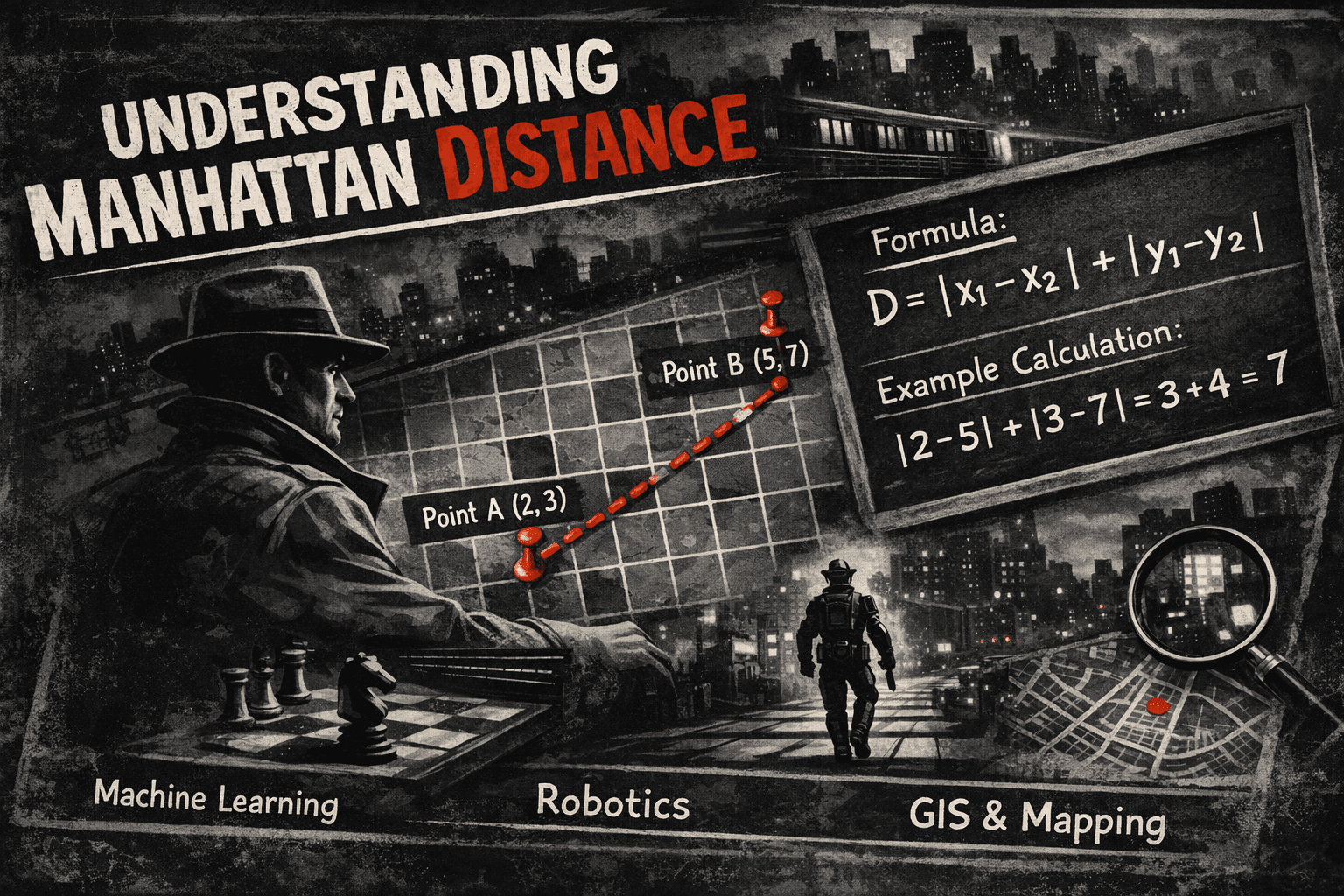
Manhattan distance, also known as taxicab distance or L1 distance, is defined as the sum of the absolute differences of their Cartesian coordinates. Named after the grid layout of streets in Manhattan, New York, this distance metric calculates how far apart two points are when moving along axes at right angles.
Formula for Manhattan Distance
The formula to calculate Manhattan distance between two points, and , is given by:
Where:
- is the Manhattan distance.
- is the absolute difference in the x-coordinates.
- is the absolute difference in the y-coordinates.
Applications of Manhattan Distance
Manhattan distance has several applications across different domains:
In Machine Learning
In machine learning, Manhattan distance is often used in clustering algorithms, such as K-means clustering and K-nearest neighbors (KNN). It helps to determine the similarity between data points, enabling effective classification.
In Robotics
Robots utilize Manhattan distance for pathfinding and navigation in grid environments. This distance metric allows robots to calculate the most efficient path to their destination without obstacles.
In Geographic Information Systems (GIS)
GIS applications use Manhattan distance to analyze spatial relationships and proximity between geographic features, such as buildings or landmarks.
How to Calculate Manhattan Distance: Step-by-Step
Calculating Manhattan distance is straightforward. Here’s a step-by-step guide:
Step 1: Identify the Coordinates
Identify the coordinates of the two points you want to measure. For example:
- Point A:
- Point B:
Step 2: Apply the Formula
Using the formula:
Substituting the values:
Step 3: Interpret the Result
The Manhattan distance between points A and B is 7 units.
Common Pitfalls When Using Manhattan Distance
While using Manhattan distance can be beneficial, there are some pitfalls to be aware of:
Ignoring Dimensions
Manhattan distance is primarily suited for two-dimensional or multi-dimensional grid systems. Applying it to non-grid systems may yield misleading results.
Misunderstanding the Metric
It's essential to understand that Manhattan distance does not account for diagonal movement. If your application requires diagonal distance, consider using Euclidean distance instead.
Optimizing Manhattan Distance Calculations
To enhance the efficiency of calculations involving Manhattan distance, consider the following optimization strategies:
Pre-computation of Distances
In applications involving numerous distance calculations, pre-computing distances for a set of points can save time during runtime.
Leveraging Data Structures
Using data structures like KD-trees can optimize nearest neighbor searches, reducing the number of distance calculations required.
Parallel Processing
If working with large datasets, consider parallel processing techniques to compute distances concurrently, speeding up the overall computation time.
Conclusion
Manhattan distance is a vital metric for measuring distances in grid-based systems. Its applications span various fields, from machine learning to robotics, making it a valuable tool for data analysis and spatial computations. By understanding its theory, calculation methods, and potential pitfalls, you can effectively utilize Manhattan distance in your projects.
Key Takeaways
- Manhattan distance measures the distance between two points based on their coordinates.
- The formula for Manhattan distance is the sum of the absolute differences of coordinates.
- Applications include machine learning, robotics, and GIS.
- Common pitfalls include ignoring dimensions and misunderstanding the metric.
- Optimization strategies include pre-computation, leveraging data structures, and parallel processing.

Want help applying this in your stack?
I can help translate the pattern, workflow, or architecture described here into a practical AI agent, automation, API integration, or full-stack implementation.
Leave a Reply
Your email address will not be published. Required fields are marked *



Comments