 giovanniromero.dev
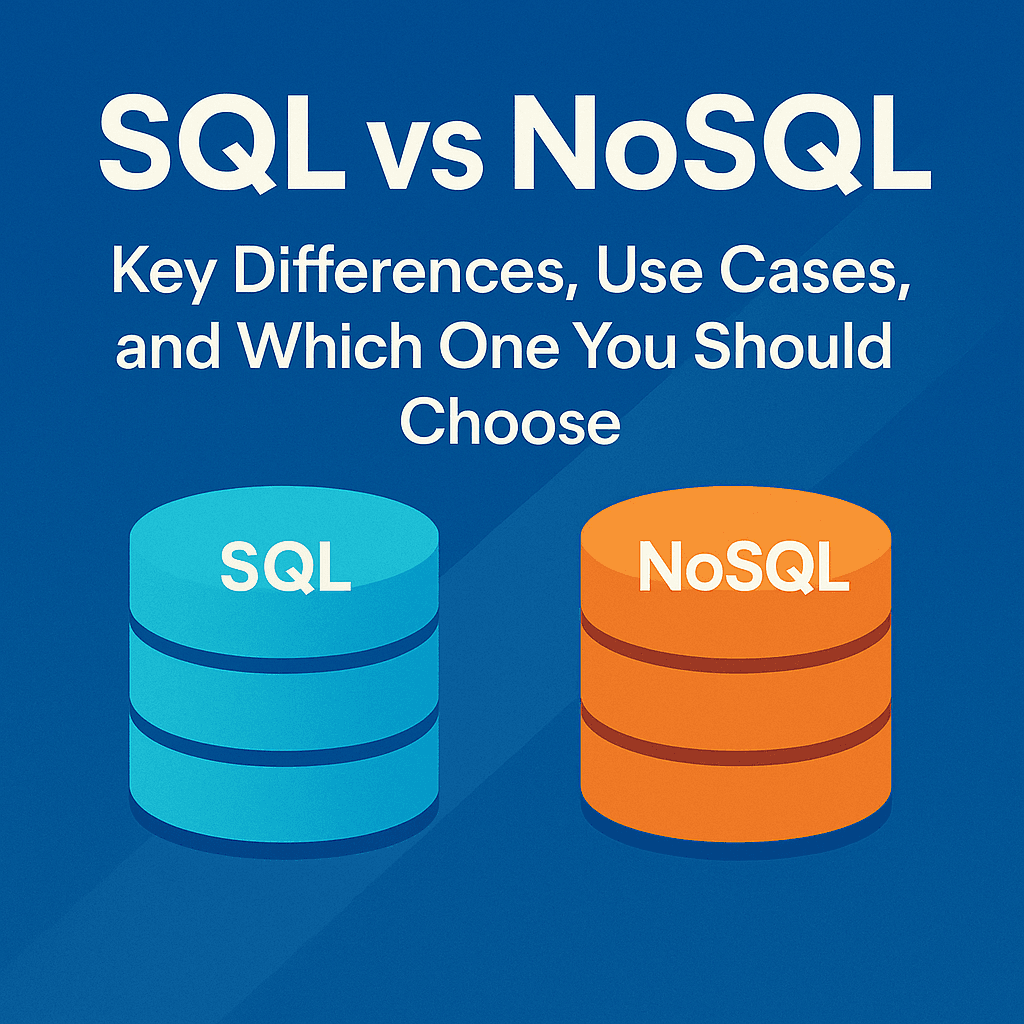
SQL vs NoSQL : Key Differences, Use Cases, and Which One You Should Choose
As digital projects grow, one of the most crucial decisions for any developer or tech team is: should you use a SQL or NoSQL database? In this updated 2025 guide, we’ll explore in detail the differences, advantages,...
As digital projects grow, one of the most crucial decisions for any developer or tech team is: should you use a SQL or NoSQL database? In this updated 2025 guide, we’ll explore in detail the differences, advantages, disadvantages, and recommended use cases to help you make the right choice.
What is SQL?
SQL (Structured Query Language) is the standard language for managing relational databases. SQL databases are composed of structured tables with fixed columns and relationships between them.
Examples of SQL databases:
- MySQL
- PostgreSQL
- SQLite
- Microsoft SQL Server
- MariaDB
Key features:
- Fixed schema: the structure must be defined before storing data.
- Relationships between tables: primary and foreign keys.
- Complex queries: using
JOIN,WHERE,GROUP BY, etc. - Strong consistency: ACID compliance (Atomicity, Consistency, Isolation, Durability).
When to use SQL:
- Financial, banking, or ERP applications.
- Projects with well-defined data structures.
- When strict data integrity is required.
What is NoSQL?
NoSQL (Not Only SQL) is a non-relational approach to managing databases. It was designed to handle large volumes of unstructured or semi-structured data.
Types of NoSQL databases:
- Document-based: MongoDB, CouchDB
- Key-value: Redis, DynamoDB
- Columnar: Cassandra, HBase
- Graph: Neo4j, ArangoDB
Key features:
- Flexible schema: you can store different structures in the same collection.
- Horizontal scalability: ideal for big data and microservices.
- High availability: many systems are designed for distributed environments.
- Eventual consistency: instead of ACID, they follow BASE (Basically Available, Soft state, Eventual consistency).
When to use NoSQL:
- Real-time applications (chat, IoT).
- Projects with semi-structured or dynamic data.
- Systems requiring massive scalability and high performance.
SQL vs NoSQL Comparison
Key differences between SQL and NoSQL:
-
Data type:
- SQL: Structured
- NoSQL: Unstructured / Flexible
-
Schema:
- SQL: Fixed (relational)
- NoSQL: Dynamic / schema-less
-
Scalability:
- SQL: Vertical (scale up)
- NoSQL: Horizontal (scale out)
-
Query language:
- SQL: Standardized SQL
- NoSQL: Varies by database
-
Data integrity:
- SQL: Strong consistency (ACID)
- NoSQL: Eventual consistency (BASE)
-
Best use cases:
- SQL: ERP, banking, traditional e-commerce
- NoSQL: Big data, mobile apps, IoT, real-time analytics
Advantages of SQL
- Maturity and stability.
- Broad support in tools and frameworks.
- Powerful for complex relationships.
- Advanced security and access control.
Advantages of NoSQL
- Adaptability to fast-changing environments.
- High performance for large volumes.
- Ideal for hierarchical or JSON-like data.
- Easier to scale horizontally.
Disadvantages of SQL
- Less flexible when changing structures.
- Limited scalability in very large projects.
- Learning curve for complex queries.
Disadvantages of NoSQL
- Less standardization between technologies.
- Weaker relational data control.
- Learning curve in efficient schema design.
Which One Should You Choose in 2025?
Choosing between SQL and NoSQL depends on your use case, team, and scalability needs:
Use Cases and Best Options:
- Order and invoice management: SQL
- Mobile app with millions of users: NoSQL
- Custom CRM or ERP system: SQL
- Real-time analytics application: NoSQL
- Small e-commerce project: SQL
- Social network-style platform: NoSQL
Pro tip: many modern projects combine both technologies (e.g., PostgreSQL + Redis or MySQL + MongoDB).
Frequently Asked Questions (FAQ)
Which database is faster: SQL or NoSQL?
It depends on the query type. NoSQL is usually faster for high-volume, non-relational data. SQL is faster for complex relational queries.
Can SQL scale like NoSQL?
Yes, but with more effort. SQL scales vertically (better hardware), while NoSQL easily scales horizontally (more servers).
Is MongoDB better than MySQL?
Not better, just different. MongoDB is great for dynamic documents and high volume. MySQL is better for structured, relational data.
Which one is better for beginners?
SQL is more structured and teaches solid fundamentals. NoSQL is more flexible. Ideally, learn both progressively.
Conclusion
SQL and NoSQL are not competitors—they complement each other. Each one has unique strengths that are better suited for different scenarios. If you’re just starting out, learn SQL first to understand data structures well, then move on to NoSQL when your project requires it.
In 2025, mastering both will give you a competitive edge as a developer

Want help applying this in your stack?
I can help translate the pattern, workflow, or architecture described here into a practical AI agent, automation, API integration, or full-stack implementation.
Leave a Reply
Your email address will not be published. Required fields are marked *

Comments