 giovanniromero.dev
Understanding AI Agents: Definition, Functionality, and Applications
What is an AI Agent and How Does it Work? Artificial Intelligence AI agents are sophisticated systems designed to perceive their environment, reason about it, and take actions to achieve specific goals. This article...
What is an AI Agent and How Does it Work?
Artificial Intelligence (AI) agents are sophisticated systems designed to perceive their environment, reason about it, and take actions to achieve specific goals. This article will delve into the concept of AI agents, how they function, and their applications across various domains. By understanding AI agents, we can appreciate their growing importance in technology and society.
What is an AI Agent?
AI agents can be defined as entities that can observe their environment through sensors, make decisions based on that information, and act upon the environment through actuators. They can be classified into two main categories: reactive agents and deliberative agents.
Reactive Agents
Reactive agents operate based on a set of predefined rules. They respond to environmental stimuli without internal reasoning. For example, a simple thermostat is a reactive agent that adjusts the temperature based on the current room temperature.
Deliberative Agents
Deliberative agents, on the other hand, possess a more complex structure. They have a model of the world and can plan their actions based on goals and predictions. For instance, an AI-based personal assistant like Siri or Alexa can understand user commands, predict needs, and perform tasks accordingly.
How Do AI Agents Work?
AI agents function through a series of processes that involve perception, reasoning, and action. Let's break down these processes:
1. Perception
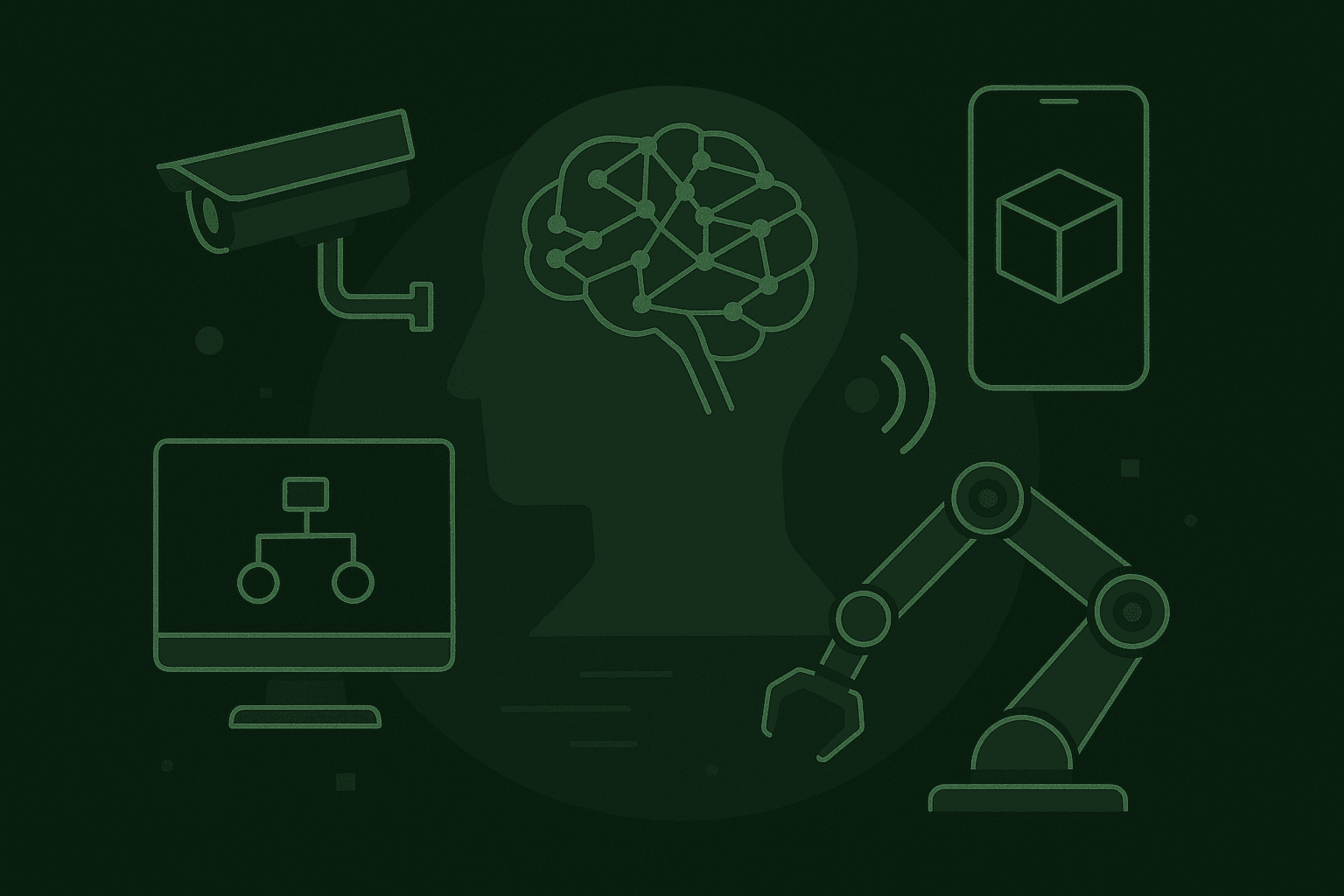
AI agents perceive their environment using sensors. These sensors can be anything from cameras and microphones to data inputs from the internet. The information gathered is then processed to form a representation of the environment.
Example: Image Recognition
In image recognition, an AI agent uses a camera sensor to capture images, which are then analyzed using convolutional neural networks (CNNs) to identify objects.
2. Reasoning
Once the agent has perceived its environment, it uses reasoning to process the information. This involves evaluating the data against its knowledge base and making decisions based on predefined algorithms or learned models.
Example: Decision Trees
Decision trees are commonly used for reasoning in AI agents. They help in making decisions by splitting data into branches based on feature values, leading to actionable outcomes.
3. Action
After reasoning, the AI agent takes action through actuators. These could be physical actions, like moving a robotic arm, or virtual actions, like sending an email.
Example: Robotic Arm
A robotic arm controlled by an AI agent can pick up objects based on the information it processes from its sensors. The action is determined by the reasoning process that evaluates the best way to achieve the task.
Applications of AI Agents
AI agents are utilized in various fields, showcasing their versatility and effectiveness.
1. Autonomous Vehicles
Self-driving cars are a prime example of AI agents in action. They perceive their surroundings using a combination of cameras, lidar, and radar, reason about traffic conditions, and make driving decisions without human intervention.
2. Virtual Assistants
AI agents like Google Assistant and Amazon Alexa help users manage daily tasks by understanding voice commands, providing information, and controlling smart home devices.
3. Gaming
In the gaming industry, AI agents control non-player characters (NPCs) to enhance gameplay. They adapt their strategies based on player actions, providing a more immersive experience.
Common Pitfalls in AI Agents
While AI agents are powerful, there are common pitfalls to be aware of:
1. Overfitting
When an AI agent is trained too well on a specific dataset, it may fail to generalize to new data. This is known as overfitting and can lead to poor performance in real-world scenarios.
2. Lack of Explainability
Many AI agents operate as black boxes, making it difficult to understand how they arrive at decisions. This lack of transparency can be problematic, especially in critical applications like healthcare.
Optimizing AI Agents
To enhance the performance of AI agents, several optimization techniques can be employed:
1. Reinforcement Learning
Reinforcement learning allows AI agents to learn from their actions by receiving rewards or penalties. This method helps them improve their decision-making over time.
2. Transfer Learning
Transfer learning involves taking a pre-trained model and fine-tuning it on a new task. This approach can significantly reduce training time and improve performance, especially when data is scarce.
Conclusion
AI agents are essential components of modern technology, capable of perceiving, reasoning, and acting in various environments. By understanding their functionality and applications, we can harness their potential to create innovative solutions across multiple domains.
Key Takeaways
- AI agents are entities that perceive, reason, and act.
- They can be classified into reactive and deliberative agents.
- Key processes include perception, reasoning, and action.
- Applications range from autonomous vehicles to virtual assistants.
- Common pitfalls include overfitting and lack of explainability.
- Optimization techniques like reinforcement learning can enhance performance.

Want help applying this in your stack?
I can help translate the pattern, workflow, or architecture described here into a practical AI agent, automation, API integration, or full-stack implementation.
Leave a Reply
Your email address will not be published. Required fields are marked *
Comments